NCCCO ABC · ABW · ABL · Self-paced written prep
Articulating Crane Exam Prep for Alaska Knuckleboom Drivers
A knuckleboom does a lot of Alaska's quiet lifting. Supply yards in Anchorage, the Mat-Su and the Kenai Peninsula send trucks out daily with bundled studs, drywall and roofing, and the driver is also the crane operator. Off the road system the picture changes: building materials, housing units and equipment ride summer barges to river and coastal villages, and a truck-mounted crane is often what gets them off the landing. This course prepares you for the NCCCO articulating crane written exams so the knowledge side of certification is handled before you book a practical with an accredited examiner.
Content last reviewed
Topics in this prep
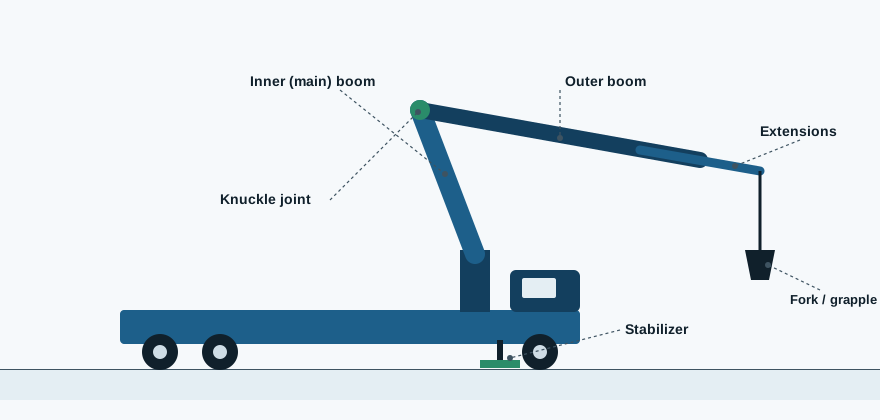
- How folding boom sections, extensions and a jib change reach and capacity
- Reading articulating load charts section by section
- Stabilizer placement, cribbing and level on gravel pads and thawing shoulders
- Radio remote and seat-control operation, including blind picks
- Forks, clamshells, grapples and cradles, and what each one deducts from capacity
- Automatic overload prevention and why it decides some regulatory questions
- Winch line, hook block and basic rigging for the ABW designation
- Overhead line clearance on residential and village streets
- Which delivery tasks fall inside or outside OSHA Subpart CC
Route work around Anchorage versus a barge landing in the bush
On the road system, most knuckleboom days follow a pattern: load at the yard, drive to a subdivision or commercial job, find somewhere firm for the stabilizers and set product where the builder wants it. Job ads from Anchorage-area building suppliers routinely list knuckle boom and boom truck experience as a driver requirement, which tells you how common the machines are in town.
Rural deliveries are less predictable. Many western and northern communities get heavy freight only during the ice-free months, and state planning documents describe shoreside receiving areas that are basic or missing altogether. Projects have moved military barracks modules by rail to Seward and then by charter barge to a new village site, with a crane carried on the barge for offloading. A housing research project in Unalakleet planned to lift a plumbed utility core off the barge with a boom truck and haul it inland over gravel roads. Lifts like those are rarely simple ground drops, and they tend to be where certification matters most.
Reading 1926.1400(c)(17) carefully
Alaska's construction safety rules are the federal ones adopted by reference and enforced by AKOSH, so the knuckleboom exclusion in Subpart CC applies here as written. It has three parts, and drivers tend to remember only the first.
Part (i) excludes an articulating or knuckle-boom truck crane that delivers material to a construction site by transferring it from the truck to the ground, as long as the load is not arranged in a particular sequence for hoisting. Part (ii) excludes placing sheet goods or packaged materials onto a structure, such as plywood, sheetrock, bagged cement, shingle bundles or rolls of roofing felt, but only with a fork or cradle at the boom tip and a working automatic overload prevention device. Part (iii) takes the exclusion away when the crane holds, supports or stabilizes material so a crew can fasten it, when the load is a prefabricated component like trusses or precast panels, or when it is structural steel such as joists, beams, columns or decking.
In practice that means one truck can be outside the crane standard at 9 a.m. and inside it by noon. OSHA has also explained in interpretation letters that the ground-delivery exclusion lines up with its broader policy on materials dropped at construction sites. If your work ever crosses into part (iii), operator certification under 1926.1427 and an employer evaluation come with it.
- Truck to ground, not staged for hoisting: excluded
- Sheet goods onto a roof with a fork or cradle and working overload protection: excluded
- Holding a beam while a crew bolts it, setting trusses or precast: covered
- Lifting steel joists, columns or decking: covered
Choosing ABC, ABW or ABL
NCCCO's articulating program has three written exams. The Articulating Boom Crane (ABC) exam fits the typical delivery knuckleboom without a winch. The Articulating Boom Crane with Winch (ABW) exam is for units that hoist with a wire rope, hook block and winch; NCCCO pairs that written exam with the Articulating Boom Crane practical. The Articulating Boom Loader (ABL) exam suits grapple-style loaders used on logs, scrap or pipe.
You pass one written exam and at least one matching practical, in either order, and both must be done within 12 months of the first pass. Written exams can be scheduled through online proctoring, at a test center or at a testing event. The practical is always done on a real machine at an approved site, which for most Alaskans means planning a trip to wherever an examiner is set up.
Setup problems the exam expects you to solve
Alaska job sites give you plenty of practice. A gravel pad that held firm in February can go soft in May as the ground thaws, and a road shoulder over thaw-weak soil may not carry a stabilizer foot at all. Cribbing, pads and a second look at the surface are worth more than a few feet of extra reach.
Cold changes the machine too. Hydraulic oil thickens, functions respond slowly until the system warms, and manufacturers set their own guidance for low-temperature operation, so read the manual for your crane. Wind is the other variable: bundles of sheathing and insulation catch gusts, and coastal towns and mountain passes can see strong wind with little warning. The written exam asks the same questions in chart and procedure form.
How the course fits around a delivery schedule
Lessons run on a phone, tablet or laptop, so you can read a module at the yard while the truck is loaded or go through practice questions in the evening. The material starts with components and terminology, moves into stabilizers and setup, then spends real time on load charts, because articulating charts change with every boom section and extension. Later units cover attachments, inspection, operation, power lines and the federal rules. ABW candidates get added material on wire rope, hook blocks and rigging basics.
Supply companies that want several drivers certified at once can enroll a group and let each person move at their own pace.
Questions people ask
My truck has a winch on the boom. Which written exam should I book?
Book the Articulating Boom Crane with Winch (ABW) written exam. NCCCO pairs it with the Articulating Boom Crane practical, and holding ABW alongside ABC reflects that you can run the crane both ways.
We mostly unload freight at a barge landing. Does the delivery exclusion cover that?
It depends on the task, not the location. A barge landing is often not a construction site at all, and a simple transfer to the ground is excluded when it is. Setting a prefabricated unit onto a foundation or holding it while it is secured is a different matter. Talk to your employer about exactly what the lift involves.
Will a telescopic boom truck certification let me run a knuckleboom?
No. Articulating cranes have their own NCCCO program, separate from the telescopic boom designations. Your card needs to match the type of crane you operate.
How long does an NCCCO articulating certification last, and how is it renewed?
Five years. To renew you retake the written exam for your designation. If you can document at least 1,000 hours of crane-related experience during the five years, NCCCO waives the practical for recertification.
Guides that pair with this course
-
Becoming a crane operator in Alaska
The realistic paths into an Alaska crane seat, what a certifier expects before you test, and how to schedule exams around rotations, seasons and long trips.
-
NCCCO practical exam
A walk-through of the hands-on crane exam, the skills it scores, ways to build seat time beforehand, and how Alaska candidates schedule and travel for it.
-
Boom truck certification
Boom trucks fall under the federal crane rule, and the right card depends on the boom and the operator station. Here is how to match truck to certification.
Courses
-
Mobile Crane
Study for the NCCCO mobile crane written exams on your own schedule, from a rough-terrain hydro in a Mat-Su subdivision to a crawler on a Kenai Peninsula bridge or a crane barged into a village for the summer.
-
Service Truck Crane
Exam prep for the NCCCO service truck crane credential, written for mechanics and lube techs who run a small telescopic crane off the back of a service body.
-
Rigger I
Get ready for the NCCCO Rigger Level I written exam with lessons on slings, hitches, hardware and inspection, aimed at Alaska workers who hook and unhook routine loads.
Line up your crane certification prep from anywhere in Alaska
Let us know the card you need — operator, rigger or signal person — and the community you work out of, whether that's on the road system or off it. An enrollment advisor writes back with a matching course and a plan for getting your written and practical exams on the calendar.
- Lessons open around the clock, on any phone, tablet or laptop
- Practice questions shaped like the NCCCO written tests
- Help mapping out where and when to take your hands-on practical
Ask about enrollment
A short form. Your details are used only to reply to you.