NCCCO TSS-STC · Mechanics' cranes · Study on any device
Service Truck Crane Certification Prep for Alaska Field Mechanics
A mechanic's truck with a crane on the back is one of the most useful machines on any Alaska job, and one of the easiest to underestimate. On the North Slope, oilfield contractors hire heavy-equipment field mechanics who work out of a dedicated service truck and travel between pads to repair loaders, trucks and rough-terrain cranes. In Fairbanks, Anchorage and around Kenai and Nikiski, road-service techs pull engines and swap components in yards and at remote sites. NCCCO built its Service Truck Crane program for exactly these operators, and this course gets you ready for its written exam.
Content last reviewed
Topics in this prep
- Service crane components, from the turret and boom sections to the hoist and controls
- Load charts for short booms and low capacities, including deductions
- Outrigger and stabilizer setup next to the machine being repaired
- Operating from the ground with a radio remote or pendant while walking with the load
- Pre-use and frequent inspections, wire rope and hook checks
- Lifting engines, final drives, tires and components safely
- Hand signals and working with a second person on the pick
- Power line distances and the 20-foot rule
- When OSHA Subpart CC applies to a mechanic's truck and when it does not
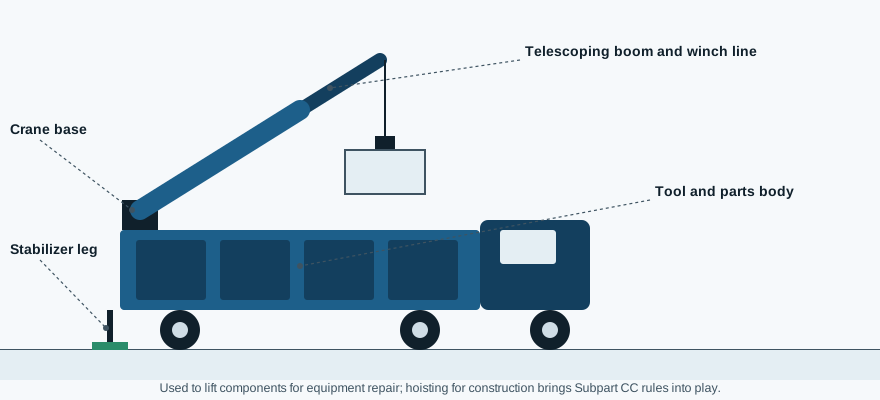
Where service cranes work in Alaska
Oilfield service is the obvious example. Recent North Slope postings for heavy-equipment field mechanics at Prudhoe Bay and Kuparuk describe working mainly from a service truck, maintaining heavy trucks and oilfield equipment including rough-terrain cranes, on a rotation schedule with North Slope safety training required. The crane on that truck lifts cylinders, starters and wheel assemblies far from any shop.
Interior and Southcentral fleets use the same machines differently: tire crews on gravel haul trucks, road-service calls on the Parks and Glenn Highways, and contractors who keep a service body on site for the summer season. Hard-rock and coal mines are a separate case. They fall under MSHA rather than OSHA, yet many mine operators and their contractors still ask service-truck operators for third-party certification before they are allowed on site.
The maintenance exclusion and its limits
Federal Subpart CC, adopted in Alaska and enforced by AKOSH for most employers, lists service and mechanic trucks with a hoisting device among the equipment it covers. A separate exclusion at 1926.1400(c)(9) then removes a mechanic's truck with a hoisting device when it is used in activities related to equipment maintenance and repair.
So the question is what the crane is doing. Pulling a transmission out of a dozer is maintenance. Using the same truck to set a pump skid, lift pipe onto a rack or hoist materials for a building project is construction hoisting, and the operator certification and employer evaluation rules in 1926.1427 follow. Mechanics often move between those jobs without noticing, which is one reason contractors standardize on a certified crew.
TSS-STC compared with full TSS
NCCCO's service truck credential is a restricted version of its Telescopic Boom Crane, Fixed Cab certification and appears on the card as TSS-STC. Holding it limits you to service truck cranes. Someone already certified in TSS does not need STC to run one, but STC does not let you move up to a larger fixed-cab boom truck.
For a mechanic who will never operate anything bigger than the crane on the service body, STC is usually the more direct route. If there is a chance you will be asked to run a larger telescopic boom truck on a construction job, compare the two before you schedule anything; our mobile crane course covers the broader TSS material.
Running the crane from the ground, in the cold
NCCCO notes that service truck cranes are usually operated with a radio remote or pendant while the operator stands on the ground and follows the load. That changes the hazards. You can see the pick up close, but you are also walking on ice, snow berms and uneven pad edges while your attention is on the hook.
The STC practical exam reflects this style of operation. It is built around five main tasks that get harder as you go, testing inspection, hoisting, booming, swinging, hand signals and combined functions, both with and without a load. NCCCO also asks candidates to watch its candidate video shortly before the practical.
Winter adds its own checklist. Batteries in remote transmitters fade in deep cold, hydraulic response is sluggish until the oil warms, and a stabilizer pad set on packed snow can settle once the sun or an engine heater softens it. None of that is exotic to an Alaska mechanic, but the written exam will expect you to connect it to inspection and setup procedure.
Inside the online course
The course is organized around the questions STC candidates find hardest: reading short-boom load charts, calculating deductions for hooks and lifting devices, and recognizing when capacity is limited by stability rather than structure. Practice questions follow each unit, and you can repeat them as often as you like on a phone during a rotation or at home between hitches.
Study covers the knowledge portion only. The practical is taken in person with an accredited examiner, and your employer still evaluates you on the specific truck before you use it for covered work.
Questions people ask
I only use my crane to pull parts off machines I'm fixing. Is certification required?
Maintenance and repair use of a mechanic's truck is excluded from Subpart CC under 1926.1400(c)(9). Certification becomes a requirement when the crane is used for construction hoisting. Many oilfield and mine contractors ask for it either way, so check with your employer or the site owner.
Can I study during a two-week rotation on the Slope?
Yes. The course runs on a phone, tablet or laptop, so you can work through a unit after shift whenever you have a connection.
Do I have to pass the written and practical in a set order?
No. NCCCO lets you take either one first, but you need to pass both within twelve months of each other.
Is an MSHA-regulated mine going to accept an NCCCO service crane card?
MSHA has its own training rules, and each mine sets its site-access requirements. NCCCO certification is widely recognized, but ask the mine or your contractor's safety lead what they require before you plan around it.
Guides that pair with this course
-
Crane certification cost
Where the money goes when you certify from Alaska, why travel can outweigh exam fees, and what federal law says about employers covering the bill.
-
NCCCO written exam online
How remote-proctored NCCCO written exams work, what your computer and room need, and how to make it go smoothly on a rural connection or during a rotation.
-
Power line clearance
The OSHA clearance distances by voltage, the planning steps required before a crane works near a line, and the Alaska conditions that quietly shrink your margin.
-
Boom truck certification
Boom trucks fall under the federal crane rule, and the right card depends on the boom and the operator station. Here is how to match truck to certification.
-
Crane operator pay in Alaska
How to read federal wage estimates for crane and tower operators in Alaska, what the last clearly published figures showed, and why a job offer can differ from the survey.
Courses
-
Mobile Crane
Study for the NCCCO mobile crane written exams on your own schedule, from a rough-terrain hydro in a Mat-Su subdivision to a crawler on a Kenai Peninsula bridge or a crane barged into a village for the summer.
-
Articulating Crane
Self-paced study for the NCCCO articulating crane written exams, with or without a winch, aimed at Alaska drivers who run a knuckleboom on a delivery truck.
-
Rigger I
Get ready for the NCCCO Rigger Level I written exam with lessons on slings, hitches, hardware and inspection, aimed at Alaska workers who hook and unhook routine loads.
Line up your crane certification prep from anywhere in Alaska
Let us know the card you need — operator, rigger or signal person — and the community you work out of, whether that's on the road system or off it. An enrollment advisor writes back with a matching course and a plan for getting your written and practical exams on the calendar.
- Lessons open around the clock, on any phone, tablet or laptop
- Practice questions shaped like the NCCCO written tests
- Help mapping out where and when to take your hands-on practical
Ask about enrollment
A short form. Your details are used only to reply to you.