NCCCO Signalperson · Hand, voice + radio
Signal Person Training for Alaska Crane Crews
When the operator cannot see where the load is going, the signal person becomes the operator's eyes. OSHA requires one whenever the operator's view of the load, its path or the landing spot is blocked, or when site conditions call for it. On Alaska jobs that happens often. Tall modules block sight lines on the North Slope, cranes work from one side of a building while the load lands on the other, and for weeks each winter much of the state works in darkness or low twilight. This course prepares you for the NCCCO Signalperson written exam at your own pace, with practice questions on hand signals, voice and radio procedure, crane behaviour and the federal rules Alaska adopts.
Content last reviewed
Topics in this prep
- The standard method hand signals in OSHA Appendix A
- Voice signal structure: function, direction, distance or speed, stop
- Radio rules: on-site testing, dedicated channels and hands-free reception
- Emergency stop and when anyone may give it
- Crane movements and how booms, loads and swing respond
- Load charts and limitations a signal person should understand
- Positioning yourself to see the load and be seen
- Coordinating signals on multiple-crane lifts
- OSHA 1926.1419–1422 and 1926.1428 requirements
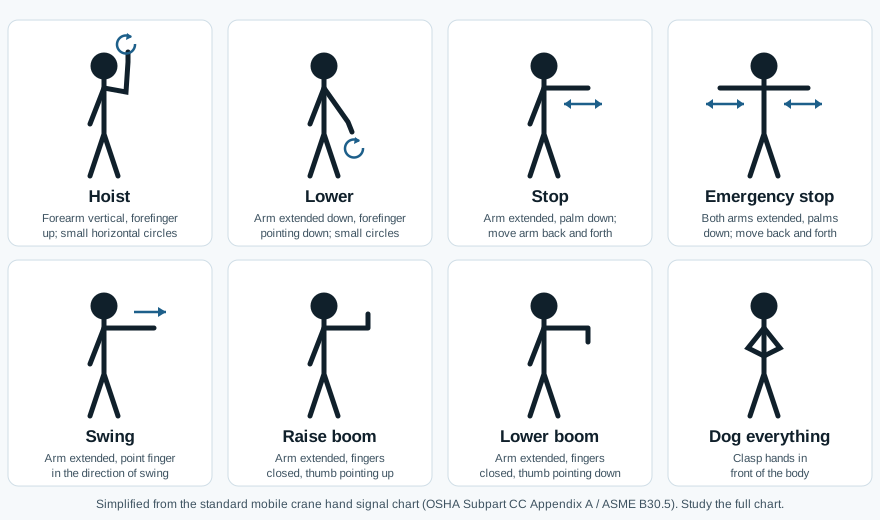
Two routes to qualification, and why portability matters
Under 1926.1428, a signal person can be qualified in one of two ways. A third-party qualified evaluator, such as an accredited certifier like NCCCO, can test and document the qualification, and that documentation travels with you to any employer. Alternatively, the employer's own qualified evaluator can assess you, but that qualification is good only for that employer and does not follow you to the next job.
Either way, OSHA expects the signal person to know and understand the signals in use, have a working grasp of crane dynamics and equipment limits, know the signaling rules in 1926.1419 through 1926.1422, and prove it through an oral or written test plus a practical test. For workers who move between contractors from season to season, as many Alaska crews do, the portable route saves repeating the process at every new hire.
Signaling through ice fog and winter dark
Ice fog settles over Fairbanks and the Fort Wainwright area once temperatures drop to around 35 below, and it thickens as the cold deepens. Visibility at ground level can collapse while the sky a few hundred feet up stays clear, so an operator in the cab may see the boom tip but not the hands of the person directing it. Fairbanks gets well under four hours of daylight around the winter solstice, and Utqiaġvik goes roughly two months without a sunrise starting in late November.
Hand signals are only useful if the operator can see them. In these conditions, crews lean on radio, lighted or reflective gloves and vests, and work lights on the landing zone. The exam does not ask about Alaska weather, but it does test the principles that make these choices necessary: the operator must have a clear view of the signal, and if communication breaks down, the crane stops.
- Choose a position where the operator can see you and you can see the load
- Switch to radio when visibility drops, and test it first
- Wear high-visibility clothing that shows up under lights
- Stop the lift when you lose sight of the load or the operator
Radio discipline on cold jobsites
OSHA's rule for electronic signals, 1926.1420, requires that radios be tested on site before the work begins, that signals travel on a dedicated channel, and that the operator receives them hands-free. Several cranes and signal persons may share one dedicated channel to coordinate their work, which is how multi-crane picks on large modules are often run.
Voice signals follow a set order under 1926.1421: the function, the direction, the distance or speed, and then the stop. Before work starts, the operator, signal person and lift supervisor agree on the voice signals they will use. Cold shortens battery life, so a spare battery and a pre-shift radio check are a practical habit wherever winter work happens.
What the NCCCO Signalperson exams look like
The written exam covers hand signals, voice communication, basic crane operation, situational awareness and the relevant standards. The practical has you demonstrate hand and voice signals for an examiner. Pass either first, then finish the other within 12 months; the certification runs for five years.
This course readies you for the written portion. Rehearse the hand signals out loud and in front of a partner, gloves on, so the practical feels familiar. Practical dates are set by the certifier, and Alaska candidates frequently plan a trip to Anchorage or Fairbanks for one.
Questions people ask
Do I need a signalman card if my employer already qualified me?
Not legally, if your employer's qualified evaluator assessed you and documented it. That qualification stays with that employer, though. A third-party certification goes with you when you change jobs.
Can I give signals by radio only, without learning hand signals?
The NCCCO exams test both. OSHA documentation also notes which signal types a person is qualified for, and most crews switch between hand and radio signals depending on distance, noise and light.
Who can call an emergency stop?
Anyone on site can give the emergency stop signal, and the operator must obey it. All other signals should come from the designated signal person.
Is this course a good fit alongside rigger training?
Yes. Many Alaska crews expect the same worker to rig and signal. Pairing this course with Rigger Level I covers both jobs below the hook.
Guides that pair with this course
-
Becoming a crane operator in Alaska
The realistic paths into an Alaska crane seat, what a certifier expects before you test, and how to schedule exams around rotations, seasons and long trips.
-
NCCCO written exam online
How remote-proctored NCCCO written exams work, what your computer and room need, and how to make it go smoothly on a rural connection or during a rotation.
-
Crane hand signals
Each standard crane hand signal described in words, the federal rules behind them, and practical ways to keep signals clear in Alaska's cold, dark and wind.
-
Power line clearance
The OSHA clearance distances by voltage, the planning steps required before a crane works near a line, and the Alaska conditions that quietly shrink your margin.
-
Cold-weather crane operations
What changes when a crane works in deep cold, darkness, ice fog and on frozen or thawing ground, and where the manufacturer's manual and the OSHA rules come in.
-
NCCCO vs NCCER
Four organizations issue accredited crane operator certifications. Here is how they differ, what accreditation proves, and how to choose for Alaska work.
Courses
-
Mobile Crane
Study for the NCCCO mobile crane written exams on your own schedule, from a rough-terrain hydro in a Mat-Su subdivision to a crawler on a Kenai Peninsula bridge or a crane barged into a village for the summer.
-
Articulating Crane
Self-paced study for the NCCCO articulating crane written exams, with or without a winch, aimed at Alaska drivers who run a knuckleboom on a delivery truck.
-
Service Truck Crane
Exam prep for the NCCCO service truck crane credential, written for mechanics and lube techs who run a small telescopic crane off the back of a service body.
Line up your crane certification prep from anywhere in Alaska
Let us know the card you need — operator, rigger or signal person — and the community you work out of, whether that's on the road system or off it. An enrollment advisor writes back with a matching course and a plan for getting your written and practical exams on the calendar.
- Lessons open around the clock, on any phone, tablet or laptop
- Practice questions shaped like the NCCCO written tests
- Help mapping out where and when to take your hands-on practical
Ask about enrollment
A short form. Your details are used only to reply to you.