Core exam + LAT · TLL · TSS
Mobile Crane Certification Prep Built Around Alaska Lifts
Mobile cranes do most of the lifting in Alaska. Two lattice-boom crawlers have been setting girders for the Juneau Creek Bridge on the Sterling Highway, the Port of Alaska in Anchorage began rebuilding its main cargo terminal in 2026, and in villages off the road system a single hydraulic crane often arrives on the summer barge and stays until freeze-up. Under the federal crane rules that AKOSH enforces here, anyone running that equipment on construction work needs a card from an accredited certifier plus an evaluation by their employer. This course gets you ready for the NCCCO mobile crane written exams through self-paced lessons and practice questions you can open on a phone, a tablet or a laptop.
Content last reviewed
Topics in this prep
- Load chart reading, capacity deductions and lifting from the correct chart for the configuration
- Outrigger and track loads, mats and cribbing on soft, thawing or frost-heaved ground
- Pre-start and frequent inspections, including what changes when the steel and oil are cold
- Rated capacity limiters and other operational aids, and the rules when one is out of service
- Electrical hazards: encroachment zones and the 20-foot default clearance for lines up to 350 kV
- Wind, visibility and daylight limits, and when the person in the seat stops the lift
- Hand signals, radio procedure and working with a qualified signal person and rigger
- Federal Subpart CC duties (29 CFR 1926.1400 series) and the ASME B30.5 basics operators are tested on
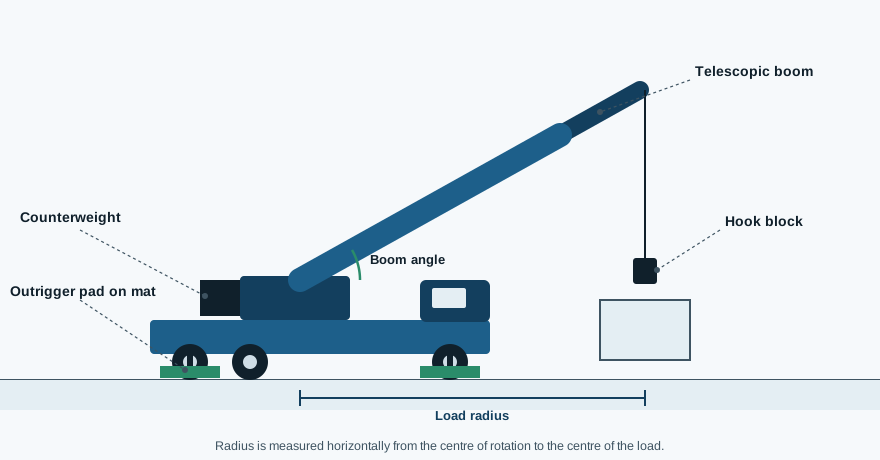
Match the specialty to the machine you will actually sit in
Everyone writes the Core exam. It is the shared knowledge base for all mobile cranes: site preparation, setup, operating practice, technical terms and the regulations. The specialty exam is where the load charts for one crane family come in, so pick it based on the iron your employer runs, not on what sounds most impressive.
Older cards may still list LBC or LBT; NCCCO merged those lattice codes into LAT. Plenty of Alaska operators end up holding two specialties because a contractor's fleet might include a rough-terrain hydro for the summer and a crawler for a bridge or dock job.
- LAT: crawlers and truck-mounted lattice machines, common on bridge, pile and port work
- TLL: rough-terrain and all-terrain hydros where the operator's cab swings with the upper
- TSS: fixed-cab telescopic machines, including many boom trucks and service truck cranes, with restricted STC and BTF options
Cold starts, brittle steel and ice fog
The exam does not ask about Alaska by name, but it does expect you to know that the manufacturer's manual governs. In the cold, that manual matters more than ever. Grove operating manuals, for example, require a hoist warm-up at ambient temperatures below 40°F, call for lubricants matched to the temperature, and set separate swing warm-up steps for colder conditions. Skipping that routine on a January morning in Fairbanks is how pumps, seals and gearboxes fail.
Steel loses toughness in deep cold, and welds, pins and sheaves are where cracks start, so a careful walk-around before the first pick is part of the job. Visibility is the other winter problem. Around Fairbanks and Fort Wainwright, ice fog builds once air temperatures drop to roughly -31°F and below, and it can leave the hook out of sight a short way above the ground. Knowing when to switch to radio signals, or to stop, is covered in the course alongside the Subpart CC rules on communication.
Ground that changes under the outriggers
Load charts assume firm, level support. A great deal of Alaska ground is neither for long. Ice-rich permafrost can lose strength when it thaws, gravel pads settle over a season, frost heave lifts slabs unevenly, and spring breakup turns firm winter access into mud. Coastal laydown areas and barge landings bring tide flats and saturated fill into the picture.
The Core material spends real time on outrigger and track pressure, mat and cribbing sizing, and the duty to confirm ground conditions before setup. Those calculations are exactly what a crew needs on a tundra pad or a riverbank landing where nobody has a geotechnical report handy.
When the crane comes in on the summer barge
Across much of western and northern Alaska, freight moves by barge during open water, and many landings have little or no shoreside equipment. A crane sent to a school addition, a water plant or a tank farm in a hub community may be the only one for hundreds of miles. If a hydraulic hose bursts or a limiter acts up, there is no replacement truck coming that afternoon.
That isolation raises the stakes on the skills the written exams test: reading the right chart for the configuration you actually rigged, catching a defect during inspection, and recognising a lift that should wait. The prep is written so a crew lead in Bethel or Kotzebue can study it as thoroughly as someone in Anchorage.
Getting from study to a card in your wallet
Written exams can be taken through NCCCO's online proctored testing from a quiet room with a reliable connection, at a test center, or at a scheduled testing event. The practical is a separate hands-on exam on the crane type you want listed, and candidates from rural Alaska usually plan travel to Anchorage, Fairbanks or the Kenai area for it; check the certifier's schedule well before the season starts. NCCCO gives a 12-month window to complete both halves for a crane type. Once you hold the card, your employer still has to evaluate you on the specific machine before you run it alone.
Questions people ask
I run a crane at a mine. Does any of this apply to me?
Mines such as Red Dog, Fort Knox or Usibelli fall under MSHA rather than the construction crane standard. Many mine operators and their contractors still ask for an accredited mobile crane card as a hiring or site-access condition, so the same prep is useful there.
What about cranes on docks or barges?
Private-sector maritime work such as longshoring, marine terminals and shipyards generally stays under federal OSHA, with its own crane rules in Parts 1915, 1917 and 1918. Contractors on port construction still commonly expect NCCCO-certified operators. Our Alaska requirements guide explains who covers what.
Is there an Anchorage or statewide crane license I need on top of NCCCO?
No. Neither the state nor any Alaska city licenses crane operators; a 2009 bill to create a state license never left committee. Accredited certification plus the employer evaluation is the standard here.
Can several people from our crew enroll together?
Yes. Employers can enroll multiple workers, and each person studies at their own pace. Send the details through the enrollment form and an advisor will reply.
Guides that pair with this course
-
Becoming a crane operator in Alaska
The realistic paths into an Alaska crane seat, what a certifier expects before you test, and how to schedule exams around rotations, seasons and long trips.
-
Crane certification cost
Where the money goes when you certify from Alaska, why travel can outweigh exam fees, and what federal law says about employers covering the bill.
-
NCCCO written exam online
How remote-proctored NCCCO written exams work, what your computer and room need, and how to make it go smoothly on a rural connection or during a rotation.
-
NCCCO practical exam
A walk-through of the hands-on crane exam, the skills it scores, ways to build seat time beforehand, and how Alaska candidates schedule and travel for it.
-
Crane hand signals
Each standard crane hand signal described in words, the federal rules behind them, and practical ways to keep signals clear in Alaska's cold, dark and wind.
-
Reading a crane load chart
A plain walk-through of the parts of a load chart and the order to read them in, with the Alaska conditions that a chart quietly assumes away.
Courses
-
Articulating Crane
Self-paced study for the NCCCO articulating crane written exams, with or without a winch, aimed at Alaska drivers who run a knuckleboom on a delivery truck.
-
Service Truck Crane
Exam prep for the NCCCO service truck crane credential, written for mechanics and lube techs who run a small telescopic crane off the back of a service body.
-
Rigger I
Get ready for the NCCCO Rigger Level I written exam with lessons on slings, hitches, hardware and inspection, aimed at Alaska workers who hook and unhook routine loads.
Line up your crane certification prep from anywhere in Alaska
Let us know the card you need — operator, rigger or signal person — and the community you work out of, whether that's on the road system or off it. An enrollment advisor writes back with a matching course and a plan for getting your written and practical exams on the calendar.
- Lessons open around the clock, on any phone, tablet or laptop
- Practice questions shaped like the NCCCO written tests
- Help mapping out where and when to take your hands-on practical
Ask about enrollment
A short form. Your details are used only to reply to you.