NCCCO Rigger I · Self-paced written prep
Rigger Level I Prep for Alaska Ground Crews
A crane can only be as safe as the hitch hanging from it. Rigger Level I is the NCCCO credential for the person doing that work on routine lifts: picking the right sling, choosing a hitch, checking shackles and hooks, and keeping people clear while the load moves. The certifier frames Level I around tasks where the load weight and center of gravity are already known. In Alaska that covers a lot of daily work, from hooking rebar bundles on an Anchorage building to slinging pipe in a Kenai yard or loading freight at a river landing. This course gets you ready for the written exam on your own schedule, from a phone, tablet or laptop, between shifts or during a camp rotation.
Content last reviewed
Topics in this prep
- Wire rope, alloy chain, web and round sling construction
- Choker, basket and vertical hitches and their capacity effects
- Reading sling tags and working load limits
- Shackles, hooks, eyebolts, swivel hoist rings and wedge sockets
- Pre-use inspection and when to pull gear from service
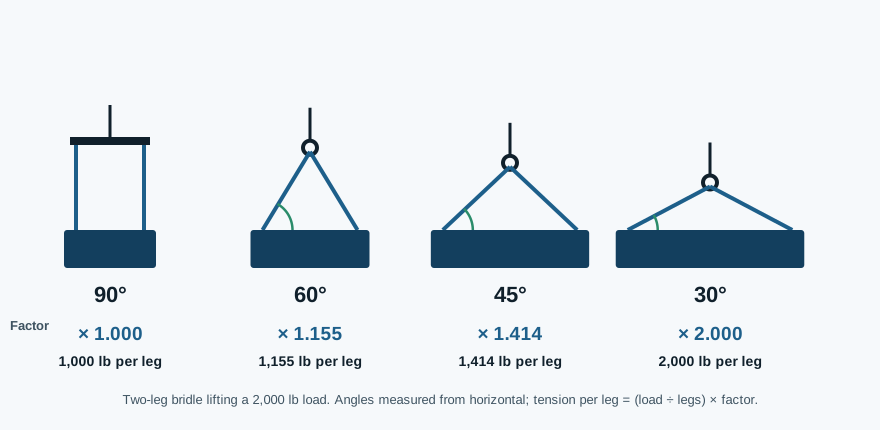
- Sling angles and the tension they add to each leg
- Tag line use and staying out of the fall zone
- Hand signals a rigger is expected to know
- Qualified rigger duties in OSHA Subpart CC
What a Level I rigger is trusted to do
Think of Level I as the credential for repeatable, well-defined picks. Someone has already worked out what the load weighs and where its balance point sits; your job is to select gear rated for it, rig it so it hangs level, inspect everything before it goes up, and control the area around it. That is most of the hooking and unhooking that happens on any jobsite.
Work that requires you to figure out an unknown weight, locate a center of gravity on an odd-shaped object, or plan a rig with several attachment points belongs to Rigger Level II. Many Alaska workers earn Level I first and add Level II once they are leading picks.
Rigging gear at forty below
Winter in the Interior and on the North Slope puts rigging hardware near the edge of its published ratings. Sling makers and industry guides commonly list about -40°F as the lower limit for nylon and polyester web and round slings, and guidance for wire rope slings generally treats -40° as the point where you stop and consult the manufacturer. Chain is less uniform: some grades are rated lower than others, so the grade stamped on the link and the maker's data decide what is allowed, not habit.
Hardware sold for cold service is usually marked with a minimum temperature and backed by impact testing. A standard shackle may still be fine on a cold day, but it has not been proven for it. On a frozen job, the Level I mindset is simple: know the rating, read the tag, and ask before you guess.
Ice and packed snow cause their own trouble. Frost on a load adds weight nobody calculated, frozen mud can hide a cracked lug or a bent eye, and a sling frozen to the ground can tear when someone yanks it free. Wide, flat pieces like wall panels and roof sections catch the gusts that run through places like Turnagain Arm, Whittier and the Aleutians, so tag lines and a clear fall zone matter even on a light pick.
- Check the sling tag for its temperature range, not just its capacity
- Knock ice off attachment points and look again before hooking
- Store synthetic slings dry so they do not freeze stiff
- Treat a load that has sat outside overnight as heavier than its paperwork says
Where the qualified-rigger rule comes from
Alaska's AKOSH program adopts the federal crane standard, 29 CFR 1926 Subpart CC, by reference. Two sections drive rigger qualification. Under 1926.1425(c), workers hooking, unhooking or guiding a load inside the fall zone, or making the initial connection to a structure, must be qualified riggers. Under 1926.1404(r)(1), rigging during crane assembly and disassembly must also be done by a qualified rigger.
OSHA leaves the qualification call to the employer and does not demand a certification card. In practice, a third-party credential gives that decision a record behind it, and many owners and prime contractors on Alaska oil, defense and infrastructure jobs list certified riggers in their site rules. Mines such as Fort Knox or Red Dog fall under MSHA rather than AKOSH, yet contractors there often ask for the same card.
Written knowledge, hands-on proof
NCCCO certifies riggers through two separate tests. The written exam checks what you know about slings, hitches, hardware, inspection and signals. The practical has you work with real gear in front of an examiner: identifying components, inspecting them, tying knots and rigging a load. Either one can come first, and once one is passed you have 12 months to finish the other.
This course covers the written side. The practical requires real slings in your hands, so line up time with your crew or employer to rehearse knots and inspections, and plan around the certifier's schedule, since candidates often travel to Anchorage or Fairbanks for a test date.
How the lessons are laid out
Each topic is a short module with practice questions at the end: sling materials, hitches, hardware, inspection, angles, signals and the OSHA rules. Sling-angle questions get their own drill set because the math is where many candidates lose points. Lessons are self-paced and open on any device, so a study session fits into a break at camp or an evening at home during the long winter. Employers can also enroll several crew members at once through the enrollment form.
Questions people ask
Is a Rigger I card required to hook loads on an Alaska job?
Federal and AKOSH rules require a qualified rigger in specific situations, but they do not require certification. Many employers and project owners in the state set the certified card as their own minimum, so check your site's requirements.
Does extreme cold change what I need to know for the exam?
The written exam is national, so it does not ask Alaska-specific questions. It does test temperature limits, inspection criteria and removal-from-service rules, which are exactly the points that matter more when gear is used in deep cold.
I already work as a signal person. Is Rigger I still worth it?
Often yes. Rigging and signaling overlap on most crews, and holding both credentials lets one person cover more of the work below the hook. Our Signal Person course pairs naturally with this one.
What happens if my Rigger I certification expires?
The card is valid for five years. Plan the renewal well before the expiration date and check NCCCO's current rigger recertification rules, since letting it lapse can mean retesting from the start.
Guides that pair with this course
-
Becoming a crane operator in Alaska
The realistic paths into an Alaska crane seat, what a certifier expects before you test, and how to schedule exams around rotations, seasons and long trips.
-
NCCCO written exam online
How remote-proctored NCCCO written exams work, what your computer and room need, and how to make it go smoothly on a rural connection or during a rotation.
-
Crane hand signals
Each standard crane hand signal described in words, the federal rules behind them, and practical ways to keep signals clear in Alaska's cold, dark and wind.
-
Rigging sling angles
The flatter a sling leg, the more tension it carries. Learn the multipliers, a field method for finding the angle, and how riggers apply it to real Alaska picks.
-
Cold-weather crane operations
What changes when a crane works in deep cold, darkness, ice fog and on frozen or thawing ground, and where the manufacturer's manual and the OSHA rules come in.
-
NCCCO vs NCCER
Four organizations issue accredited crane operator certifications. Here is how they differ, what accreditation proves, and how to choose for Alaska work.
Courses
-
Mobile Crane
Study for the NCCCO mobile crane written exams on your own schedule, from a rough-terrain hydro in a Mat-Su subdivision to a crawler on a Kenai Peninsula bridge or a crane barged into a village for the summer.
-
Articulating Crane
Self-paced study for the NCCCO articulating crane written exams, with or without a winch, aimed at Alaska drivers who run a knuckleboom on a delivery truck.
-
Service Truck Crane
Exam prep for the NCCCO service truck crane credential, written for mechanics and lube techs who run a small telescopic crane off the back of a service body.
Line up your crane certification prep from anywhere in Alaska
Let us know the card you need — operator, rigger or signal person — and the community you work out of, whether that's on the road system or off it. An enrollment advisor writes back with a matching course and a plan for getting your written and practical exams on the calendar.
- Lessons open around the clock, on any phone, tablet or laptop
- Practice questions shaped like the NCCCO written tests
- Help mapping out where and when to take your hands-on practical
Ask about enrollment
A short form. Your details are used only to reply to you.