NCCCO Tower Crane Operator · Written exam prep
Tower Crane Operator Exam Prep for Alaska and Beyond
Tower cranes are not an everyday sight in Alaska, which is exactly why qualified operators are hard to find when a project needs one. When Juneau's State Library, Archives and Museum went up, PCL stood a tower crane downtown with the cab roughly 138 feet in the air and a 230-foot reach over a tight urban block. Multi-story buildings in Anchorage, hospital and university work, and military construction around Fairbanks create similar openings from time to time. The NCCCO Tower Crane Operator certification is a separate credential from the mobile crane card, with its own written exam and a practical on the configuration you choose. This course covers the written side, self-paced and on any device.
Content last reviewed
Topics in this prep
- Tower crane types: hammerhead (trolley jib), luffing jib and self-erecting units
- Reading tower load charts: capacity versus trolley radius, jib length and counterweight
- Daily and shift inspections, brakes, limit switches and the load moment system
- Wind: in-service limits, weathervaning out of service, and reading the anemometer
- Blind lifts, radio discipline and working with a signal person you cannot see
- Assembly, climbing and dismantling roles under 29 CFR 1926.1403-1404 and 1926.1435
- Overlapping cranes, swing zones and airspace notification on busy sites
- Operator duties, fatigue and emergency procedures high above the deck
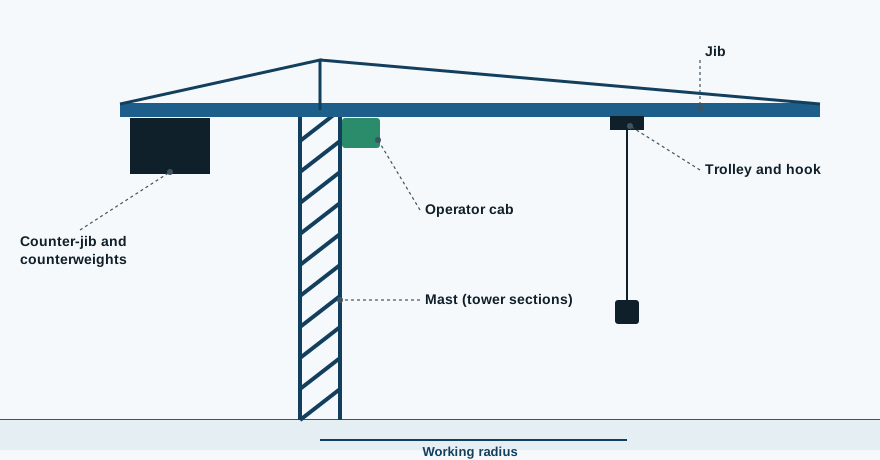
Three ways a tower crane gets the load there
A hammerhead carries its load on a trolley that runs along a horizontal jib, so radius changes without the jib moving up or down. A luffing-jib crane raises and lowers the jib itself, which lets it work in a smaller swing circle where neighbouring buildings, another crane or airspace would block a flat jib. A self-erecting crane folds up for transport and unfolds on site with little or no help from a mobile crane, making it a fit for low-rise housing, schools and smaller commercial jobs.
NCCCO uses one written exam for tower cranes and lets you choose which of these three you take the practical on. The written test leans heavily on load charts, where capacity drops quickly as the trolley moves out, and on the operator's role in inspection, wind decisions and communication. You can pass the written and practical in either order, and both have to be done inside a 12-month window.
A northern project calendar for a crane that stays put
Unlike a mobile crane that leaves at the end of the day, a tower crane can stand on one site through more than one winter. That means planning for snow and ice load on the jib and counterweight, frozen limit switches and brakes, short daylight that pushes lifts into lit conditions, and cab heating that keeps the operator alert rather than drowsy. Foundations need attention too: designers have to account for frost depth and, in parts of the Interior, permafrost, and any settlement of the base shows up as an out-of-plumb mast.
Erection and dismantling usually land in the warmer months when the mobile assist crane and rigging crew can work efficiently. Those operations fall under an assembly/disassembly director who follows the manufacturer's procedures. The exam expects operators to know how their role fits around that work, even when they are not the person directing it.
Wind off the water and through the passes
High jibs catch far more wind than anything at ground level, and Alaska's coastal and mountain-front cities, from the Southeast channels to Cook Inlet, can go from calm to gusty in an hour. Every tower crane has an in-service wind limit set by its manufacturer, and out of service the slewing brake is released so the jib can weathervane and swing freely downwind.
The course works through how to read the anemometer, why gusts matter more than averages, how large surface-area loads such as wall panels or formwork change the picture, and what a crane must be left like at the end of a shift when a storm is forecast.
Building your study around a written exam
Start with the configuration you are most likely to run, then make sure you can work load chart problems for the other two, because the written exam is not tied to your practical choice. Practice questions follow each topic so you can find weak spots before you schedule.
NCCCO lets candidates take written exams through online proctoring, at test centers or at events. The practical is a hands-on test on a real crane at an accredited site, and with so few tower cranes in Alaska, some candidates arrange it during a trip Outside; confirm locations with the certifier.
- Learn the three configurations and their charts
- Study wind, inspection and communication rules
- Take practice questions until the load math feels routine
- Schedule the written exam, then line up a practical site
- Complete your employer's evaluation on the actual crane
Questions people ask
Will a tower card let me run a mobile crane too?
No. NCCCO treats tower and mobile cranes as separate programs, each with its own written and practical exams. Many operators hold both.
Is a self-erecting crane covered by the tower credential?
Yes. Self-erecting tower cranes are one of the three practical configurations under the NCCCO Tower Crane Operator program, and the written exam covers them along with hammerheads and luffers.
Who sets the rules for tower cranes on Alaska job sites?
AKOSH enforces the federal crane and derrick standard, including the tower crane section at 1926.1435, through the state plan. The requirements guide covers the exceptions, such as federal OSHA jurisdiction on some military and maritime sites.
Should I get my mobile crane card before going for tower?
There is no rule requiring it, but many operators build seat time on mobile cranes first because those jobs are far more common in Alaska. Our mobile crane course covers that route.
Guides that pair with this course
-
NCCCO practical exam
A walk-through of the hands-on crane exam, the skills it scores, ways to build seat time beforehand, and how Alaska candidates schedule and travel for it.
Courses
-
Mobile Crane
Study for the NCCCO mobile crane written exams on your own schedule, from a rough-terrain hydro in a Mat-Su subdivision to a crawler on a Kenai Peninsula bridge or a crane barged into a village for the summer.
-
Articulating Crane
Self-paced study for the NCCCO articulating crane written exams, with or without a winch, aimed at Alaska drivers who run a knuckleboom on a delivery truck.
-
Service Truck Crane
Exam prep for the NCCCO service truck crane credential, written for mechanics and lube techs who run a small telescopic crane off the back of a service body.
Line up your crane certification prep from anywhere in Alaska
Let us know the card you need — operator, rigger or signal person — and the community you work out of, whether that's on the road system or off it. An enrollment advisor writes back with a matching course and a plan for getting your written and practical exams on the calendar.
- Lessons open around the clock, on any phone, tablet or laptop
- Practice questions shaped like the NCCCO written tests
- Help mapping out where and when to take your hands-on practical
Ask about enrollment
A short form. Your details are used only to reply to you.