Content last reviewed
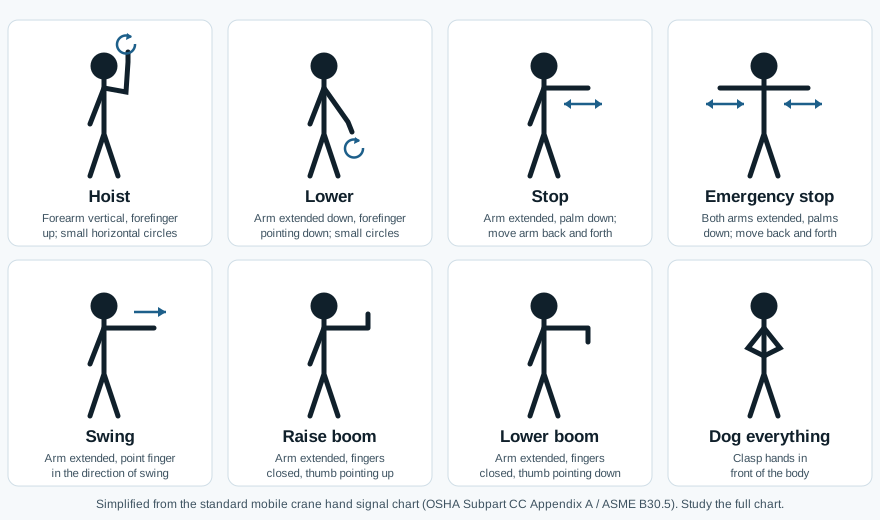
Reading the chart: the core signals in words
These descriptions follow the standard method. Practice them until your arm does them without thinking:
- Hoist: forearm vertical, index finger pointing up, hand moving in small horizontal circles.
- Lower: arm extended downward, index finger pointing down, hand moving in small horizontal circles.
- Stop: arm extended to the side, palm down, moving the arm back and forth horizontally.
- Emergency stop: both arms extended, palms down, moving both arms back and forth horizontally.
- Swing: arm extended, pointing with a finger in the direction the boom should swing.
- Raise boom: arm extended, fingers closed, thumb pointing up.
- Lower boom: arm extended, fingers closed, thumb pointing down.
- Dog everything: hands clasped together in front of the body, meaning pause all motion and hold.
What the federal rule requires
Under 29 CFR 1926.1419, which AKOSH applies through Alaska's adoption of the federal construction standards, hand signals on a construction lift must follow the Standard Method shown in Appendix A to Subpart CC. Non-standard signals are allowed only when the standard method is infeasible or when an operation or attachment is not covered by it. In that case the signal person, the operator and the lift director, if there is one, must meet before the operation and agree on the signals.
Section 1926.1422 requires the hand signal chart to be posted on the equipment or conspicuously near the hoisting operation. And 1926.1419 makes clear that anyone who becomes aware of a safety problem must alert the operator or signal person by giving the stop or emergency stop signal; the operator is required to obey it. A laborer on the far side of a load can stop the lift.
When a signal person is needed, and who qualifies
A signal person is required when the operator cannot see the load or where it will land, when the view in the direction of travel is obstructed, or when either the operator or the person handling the load decides one is needed for safety. Under 1926.1428, the signaler must be qualified either by a third-party qualified evaluator or by the employer's own qualified evaluator. The first produces documentation that travels from job to job; the second covers only that employer.
Qualification means knowing the signals, understanding basic crane operation and its limits, and demonstrating skill, not just reading a chart. Our Signal Person course covers the written side of an accredited signalperson credential.
Signals in mittens, darkness and ice fog
Alaska tests signal clarity in ways a chart does not show. Bulky winter gloves turn a pointed index finger into a vague lump, so exaggerate: make the circles for hoist and lower larger and slower, and hold the thumb signals still for a beat. A brightly colored or high-contrast glove on the signaling hand helps the operator pick out finger and thumb positions.
Short winter days mean lifts often happen under lights. Stand where the light falls on you, not behind you, and avoid positions where the operator is looking into a floodlight. Reflective sleeves or a vest with reflective trim make arm motion easier to read.
Ice fog around Fairbanks in deep cold and snow squalls anywhere can wipe out visibility in minutes. When the operator can no longer see you clearly, stop the lift or switch to radio signals under the rules for that method, rather than drifting closer to the load to stay visible.
Docks, wind and radio
On waterfront jobs in Kodiak, Seward or Valdez, wind and machinery noise often rule out voice signals, and the landing spot may be down in a barge or vessel hold the operator cannot see. Those are classic cases for a dedicated signal person, often working by radio. Subpart CC sets separate requirements for voice and radio signals; the core idea is a clear, dedicated channel and an agreed way to identify who is talking. Remember that private-sector maritime cargo handling generally falls under federal OSHA's maritime rules rather than Subpart CC, so confirm which set of rules governs a dock job before assuming.
Good habits that prevent bad lifts
Most signaling mix-ups trace back to a missing conversation before the pick. A few crew rules cover the gaps:
- One signal person at a time directs the operator, except for stop, which anyone can give.
- Agree before the lift on where the signal person will stand and what to do if they lose sight of the load.
- Keep signals in the operator's direct line of sight; step to a new position rather than signaling around an obstruction.
- If a signal is unclear, the operator should stop and wait, not guess.
- Brief any non-standard signal with everyone involved, every time the crew changes.
Questions people ask
Are crane hand signals the same everywhere in the U.S.?
For construction work under the federal crane rule, yes: the Appendix A standard method applies, and that includes Alaska. Other industries and countries may use slightly different charts, which is one reason to stick to the posted chart on each job.
Can the operator refuse a signal?
An operator who believes a requested move is unsafe should stop and resolve it before continuing. The one signal an operator must always obey is stop or emergency stop, no matter who gives it.
Does the practical crane exam test hand signals?
Yes. Following hand signals is one of the skills scored on the NCCCO mobile crane practical, so operators need to know them as well as signal persons do. See the practical exam guide.
How do I become a qualified signal person in Alaska?
Either through an accredited third-party credential, which includes written and practical testing, or through your employer's qualified evaluator. The third-party route is portable between employers, which matters if you move between seasonal jobs.