NCCCO DDO · Utility pole work · Online exam prep
NCCCO Digger Derrick Prep for Alaska Line and Telecom Crews
From Homer to the Interior, Alaska's road-system grid is run largely by member-owned cooperatives: Chugach Electric in Anchorage, Matanuska Electric Association in the Mat-Su, Homer Electric Association on the Kenai Peninsula and Golden Valley Electric Association around Fairbanks and up to Delta Junction. Beyond the Railbelt, village co-ops and telephone companies keep lines up in places where a crew may be two people and a truck. All of that work leans on the digger derrick, a machine that bores the hole, swings the pole into it and holds it plumb while it is backfilled. This course prepares operators for the NCCCO Digger Derrick Operator written exam.
Content last reviewed
Topics in this prep
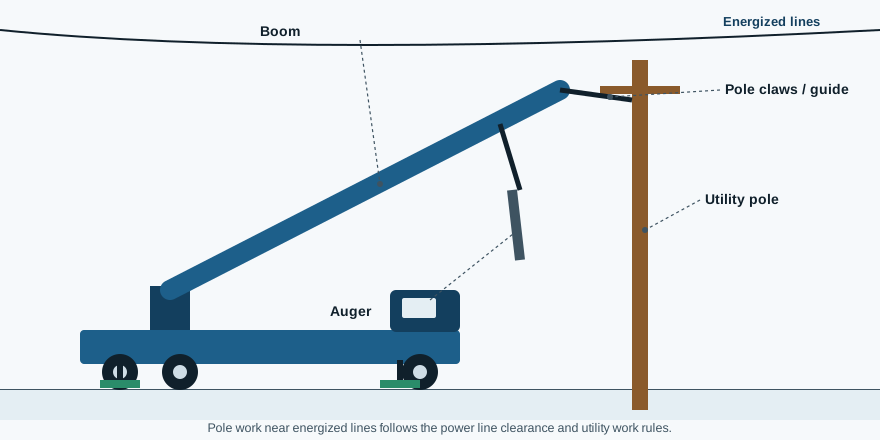
- Digger derrick components: boom, auger, pole guides, winch and outriggers
- Site evaluation for ground conditions, slope, traffic and overhead lines
- Pre-operation inspection, including auger teeth, pilot bits and hydraulic lines
- Augering technique, including hard and frozen ground
- Setting, plumbing and pulling poles with the pole claw
- Manufacturer load charts and how auger and pole-handling weight affect them
- Insulated booms, dielectric testing and minimum approach distances
- How 1926.1400(c)(4) separates exempt pole work from crane work
What frozen and thawing ground does to pole work
Augering in winter is a different job from augering in July. Frozen silt and gravel can stop a standard bit, and in permafrost areas crews may need jackhammers to finish a hole the auger started. One North Slope cooperative that uses its digger derrick to prepare winter graves has described this exact combination, and noted that frozen soil turns sticky once it is exposed to warmer air, which makes cleaning out a hole slower.
The trouble continues after the pole is set. Alaska's state geological survey defines frost jacking as poorly anchored structures being pushed upward by frost heave, and thawing permafrost can do the opposite. A telecom provider has had to repair or replace leaning poles along a swampy stretch of the Richardson Highway north of Delta Junction, and Chugach Electric has sent crews to straighten tilting poles in south Anchorage. Replacing, resetting and re-plumbing poles means more hours on the derrick, often on soft or uneven ground.
- Check auger teeth and pilot bit wear before a frozen-ground job
- Expect outrigger pads to sink as surface frost thaws
- Watch hydraulic response until the oil warms up
- Keep the work area clear of slush and ice around the hole
Where the Subpart CC exemption stops
Digger derricks get a narrow carve-out from the federal crane standard, which applies in Alaska through AKOSH's adoption of the construction rules. Under 1926.1400(c)(4), Subpart CC does not cover a digger derrick when it is augering holes for poles carrying electric or telecommunication lines, placing or removing those poles, or handling materials being installed on or removed from them, or when it is used for other work covered by Subpart V. That exclusion is only available if the work fully complies with Subpart V, or with 1910.268 for telecommunications.
The exemption follows the task, not the employer. NCCCO's guidance points out that a utility's crew is not exempt just because the company is a utility. Setting a padmount transformer on the ground involves no hole and no pole, and OSHA has treated it as covered. Installing signs, streetlights or similar structures for a construction project is also crane work, so operators doing it need accredited certification and an employer evaluation under 1926.1427.
Many Alaska utilities and contractors certify their digger derrick operators anyway, because a single crew can switch between exempt and covered tasks several times in one week.
How NCCCO tests digger derrick operators
Certification takes a passing written exam and a passing practical. You can do them in either order, but once you pass the first one you have 12 months to pass the other. Written exams are offered by online proctoring, at test centers and at scheduled testing events.
NCCCO organizes the written exam around five areas: Site, Pre-Operation, Operation, Technical Knowledge, and Manufacturers' Load Charts. Operation carries the most weight, and load charts are a large share as well, which is where most of our practice questions focus. The practical is hands-on and asks you to control a load, dig a hole and place a pole at an NCCCO-approved site. For crews in remote communities, that usually means coordinating with an employer or training center that can host an examiner and a machine.
Course outline for line crews
The material moves in the same order a crew works: arrive and read the site, inspect and set up, dig, handle the pole, then load charts and regulations. Each unit is short enough to finish during a break, and the practice sets can be repeated on a phone, tablet or laptop at any hour. Lessons on power line safety cover minimum approach distances and the role of insulated booms, without replacing the electrical safety training your utility already requires.
Utilities and contractors can enroll several crew members together so everyone studies the same material on their own timeline.
Questions people ask
Does my lineman apprenticeship already count as digger derrick certification?
No. Apprenticeship training and NCCCO certification are separate. The NCCCO credential comes only from passing its written and practical exams, though apprenticeship experience will help a lot with both.
We set poles for a telecom provider. Are we inside the exemption?
Telecommunications pole work can fall within 1926.1400(c)(4), but only if it fully meets 1910.268. Lifting other equipment or setting structures that are not poles for communication lines may take the job outside the exemption.
Is the digger derrick card the same as a crane card?
No. NCCCO's Digger Derrick Operator certification covers digger derricks only. Running a telescopic boom truck or mobile crane takes a different designation.
What does the practical exam look like?
It is a hands-on test on a digger derrick at an approved site. Candidates show they can control a load, dig a hole and place a pole while an examiner scores them.
Guides that pair with this course
-
Power line clearance
The OSHA clearance distances by voltage, the planning steps required before a crane works near a line, and the Alaska conditions that quietly shrink your margin.
-
Boom truck certification
Boom trucks fall under the federal crane rule, and the right card depends on the boom and the operator station. Here is how to match truck to certification.
Courses
-
Mobile Crane
Study for the NCCCO mobile crane written exams on your own schedule, from a rough-terrain hydro in a Mat-Su subdivision to a crawler on a Kenai Peninsula bridge or a crane barged into a village for the summer.
-
Articulating Crane
Self-paced study for the NCCCO articulating crane written exams, with or without a winch, aimed at Alaska drivers who run a knuckleboom on a delivery truck.
-
Service Truck Crane
Exam prep for the NCCCO service truck crane credential, written for mechanics and lube techs who run a small telescopic crane off the back of a service body.
Line up your crane certification prep from anywhere in Alaska
Let us know the card you need — operator, rigger or signal person — and the community you work out of, whether that's on the road system or off it. An enrollment advisor writes back with a matching course and a plan for getting your written and practical exams on the calendar.
- Lessons open around the clock, on any phone, tablet or laptop
- Practice questions shaped like the NCCCO written tests
- Help mapping out where and when to take your hands-on practical
Ask about enrollment
A short form. Your details are used only to reply to you.