Content last reviewed
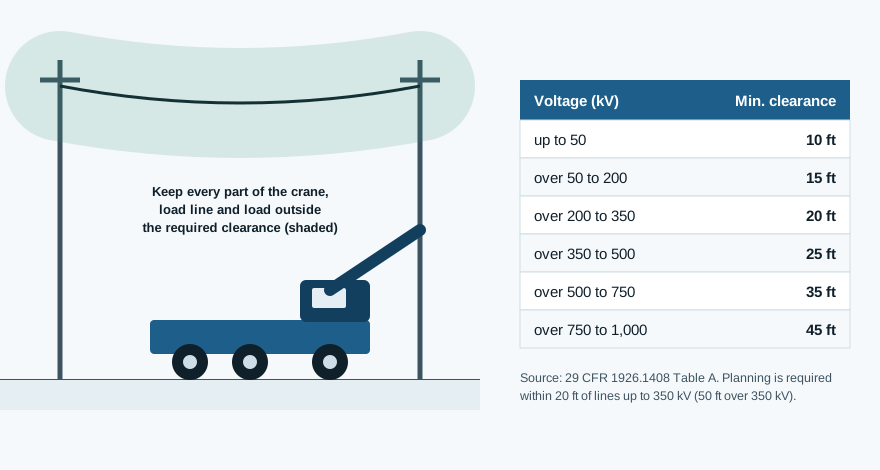
Step one: draw the work zone
Before any assembly or lifting, the employer identifies the work zone. That can be a demarcated area with flags or a range limiting device, or the full 360 degrees around the crane out to its maximum working radius. Then ask one question: could any part of the crane, the load line or the load get closer than 20 feet to a power line (or 50 feet for lines over 350 kV) if the crane operated out to the edge of that zone?
If the answer is no, you document that and proceed. If the answer is yes, or you are not sure, you pick one of the three options below. Do not forget the load and the rigging: a tag line or a swinging bundle of rebar can reach a line the boom never touches.
Step two: choose one of three paths
Section 1926.1408 gives three ways to work when the zone brushes a line:
- De-energize and ground. The utility or line owner confirms the line is de-energized and visibly grounded at the worksite. This is the safest option, and on Alaska distribution systems it often means planning an outage with the local electric cooperative or utility well ahead of time.
- Keep 20 feet (or 50 feet over 350 kV) and add protective measures. These include a planning meeting with the operator and crew, nonconductive tag lines, an elevated warning line or barricade marking the limit, and at least one more measure such as a proximity alarm, a dedicated spotter, a range control warning device, a range limiting device or an insulating link.
- Use Table A with a known voltage. The utility tells you the line voltage, and you keep the Table A distance for that voltage with the same kind of protective measures. This lets you work closer than 20 feet on low-voltage lines, but only with a confirmed voltage.
Reading Table A
The diagram on this page shows the Table A minimum clearances. In plain terms: 10 feet for lines up to 50 kV; 15 feet over 50 up to 200 kV; 20 feet over 200 up to 350 kV; 25 feet over 350 up to 500 kV; 35 feet over 500 up to 750 kV; and 45 feet over 750 up to 1,000 kV. Lines above 1,000 kV need a distance set by the utility or a registered engineer.
Most lines along Alaska roads and through towns are distribution voltage, which falls in the 10-foot band, while larger transmission lines tie communities together. You cannot tell voltage reliably by looking at the poles or counting insulators, so the rule expects you to get it from the utility. When you ask, the utility is expected to provide the voltage within two working days. Until you have it in writing, treat the line as energized and use the 20-foot default.
Traveling under lines with no load
Moving a crane under or near a line with the boom lowered and no load is covered separately by 1926.1411, which uses its own, smaller travel clearance table (Table T). It still requires a dedicated spotter when the crane will get within 20 feet of the line during travel, attention to ground conditions that can make the boom bounce, and a slower speed so the operator can stop short.
This comes up often on rural Alaska sites where the only access road passes under a service drop or distribution line. Plan the route, not just the lift.
Alaska conditions that shrink your margin
The clearance numbers do not change with the weather, but your real distance to the line does:
- Snow berms and packed snow raise the crane and the ground crew. A boom truck parked on a three-foot plowed berm is three feet closer to the line than it was in September.
- Iced and loaded conductors sag. Ice and wet snow add weight to wires and pull them lower between poles; wind can make heavily iced lines move. Measure from where the line could be, not where it was when you surveyed.
- Short daylight and ice fog make lines hard to see. In Fairbanks in December or anywhere during an ice fog event, mark lines with high-visibility markers and use lighting and a dedicated spotter.
- Wind pushes loads and load lines sideways. Gap winds around Anchorage, Whittier and the Kenai Peninsula can swing a load several feet farther than the planned radius.
- Village sites often have service lines running close to building pads, fuel tanks and airstrip edges, with little room to reposition a crane.
If contact happens
Training on the electrocution hazard is mandatory under 1926.1408 for operators and crew. The core messages: the operator stays in the cab unless there is fire or another imminent danger; everyone else stays away from the crane, the load and anything touching it; if someone must leave the machine, they jump clear with feet together and shuffle or hop away without touching the ground and the crane at the same time; and the utility is called to de-energize the line. Ground near a contact point can be energized in rings around the crane, so nobody walks toward the machine to help.
Operators in training may not operate within the 20-foot (or 50-foot) zone. Power-line content is a major part of NCCCO written exams; our mobile crane operator and digger derrick operator courses include practice questions on it. The Alaska certification requirements guide explains how these federal rules apply here.
Questions people ask
Is 10 feet always enough for a residential distribution line?
Only if the utility has confirmed the voltage is 50 kV or less and you use the required protective measures. Without a confirmed voltage you must use 20 feet. Many contractors keep 20 feet as a company minimum anyway.
Who is responsible for the power-line plan?
The employer whose crane is working must comply, and the operator, signal person and crew all have roles in the planning meeting. On multi-employer sites the controlling contractor typically coordinates with the utility. Write the plan down and review it at the start of every shift.
Do insulated booms or proximity alarms let me ignore the clearance?
No. Proximity alarms, insulating links and range limiters are listed as additional measures, not substitutes for the minimum distance. Working closer than Table A requires the separate, more demanding procedures in 1926.1410.
Does this apply to digger derricks?
Digger derricks doing pole work for electric utilities are largely handled under other standards, such as 1926 Subpart V and 1910.269, rather than Subpart CC. When the same truck does general construction lifting, the crane rules, including these clearances, can apply.