Five-year renewal · Written recert prep
Crane Recertification Refresher for Alaska's Seasonal Operators
An NCCCO mobile crane card runs for five years, and in Alaska those years go by in a pattern: a long, busy construction season, a quieter winter, and for many operators a rotation schedule that keeps them away from home for weeks at a time. Recertification fits best into the slow stretch, but only if you start before the window closes. This refresher walks back through the Core and specialty material at your own pace so the written renewal exam feels familiar, and it shows you how to assemble the experience record that can spare you a trip for another practical.
Content last reviewed
Topics in this prep
- Load chart and deduction problems to knock the rust off
- Changes in federal crane rules and ASME standards since your last test
- Operator certification versus employer evaluation under 29 CFR 1926.1427
- Power line clearance and encroachment procedures
- Ground support, mats and outrigger loads
- Wind, temperature and visibility decisions
- Signals, communication and the qualified rigger's role
- How to document hours toward the practical waiver
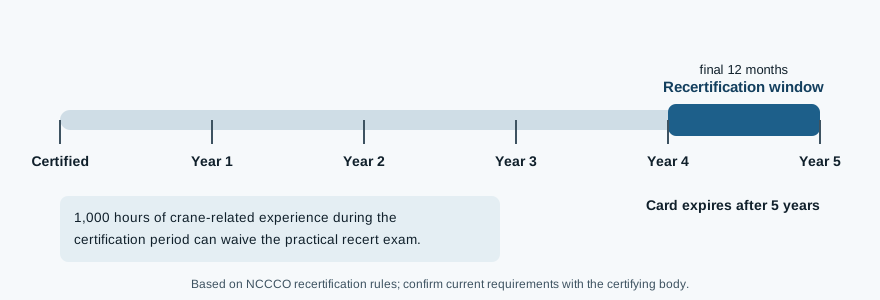
The renewal timeline in plain terms
NCCCO requires recertification candidates to finish every requirement during the 12 months before their card expires. That means passing the written recertification exam for the Core and for each specialty you want to keep. There is no grace period afterward: once the date passes, the card has lapsed and you are back to taking both written and practical exams as a new candidate.
For an Alaska operator whose card expires in late summer, the safe plan is to test the winter before rather than hoping for a free week in the middle of the season.
Write the expiration date somewhere you will see it at the start of each season, and remind your dispatcher or safety lead too. Contractors who hire for a whole summer often check cards at orientation, and a card that runs out in July can leave you parked in the yard mid-job.
Skipping the practical: what counts toward 1,000 hours
You do not need to retake the practical if you can document at least 1,000 hours of crane-related experience during your certification period. NCCCO defines that experience broadly: operating, maintaining, inspecting or training on cranes all count. A seasonal operator running a crane most days for a few summers usually clears that bar, but the hours have to be documented, not remembered.
That is where Alaska careers get messy. An operator might work for a different contractor each season, spend a stretch on a mine site, run a barge-delivered crane in a village for a summer, then rotate on the Slope. Start a simple log now: dates, employer, crane type and hours, with a supervisor contact for each job. Pay stubs, timesheets and employer letters all help.
Note that other NCCCO programs use different numbers; the digger derrick program, for example, sets its own lower threshold. Check the page for each credential you hold.
Studying on a rotation or in a quiet winter
Five years is long enough to forget the parts of the exam you never use. Operators who run the same hydro every day often find the specialty load-chart problems and the regulation questions are what slipped. The refresher is organised so you can work through a topic during an evening in camp or over a weekend at home, with practice questions to show you where to spend more time.
NCCCO's online proctored testing lets you sit the written recertification from a private room with a webcam and a stable connection, which helps in communities far from a test center. Bandwidth varies a lot across rural Alaska, so test your setup early; if it is not dependable, plan the exam during a trip to Anchorage, Fairbanks or another hub.
If you also hold a rigging or signal person credential, check those dates at the same time. Lining up every renewal in one off-season saves a second round of scheduling, and it means one study push instead of several scattered across busy summers.
What renewal does not reset
A renewed card shows you still meet the certifier's standard. It does not replace the employer's job under 1926.1427 to evaluate you on the equipment you will actually run, and a new employer or an unfamiliar machine still calls for that evaluation. If you add a specialty during the renewal period, NCCCO generally ties its expiration to your existing certification date.
- Find your expiration date and mark the 12-month window
- Gather proof of crane-related hours from every employer
- Work through the refresher and practice questions
- Schedule the written recertification exam
- Book a practical only if you fall short of 1,000 hours
Questions people ask
My card expired last month while I was on a remote job. What now?
NCCCO offers no grace period, so a lapsed card means retesting as a new candidate, written and practical. Our mobile crane course covers that full path.
Do hours on a mine crane count toward the waiver?
NCCCO counts crane-related experience such as operating, maintaining, inspecting or training on cranes, without limiting it to construction sites. Keep records showing the crane type and hours, and confirm with NCCCO if your situation is unusual.
Can I renew a tower crane card the same way?
The tower crane program has its own recertification exam with a similar structure, including the 12-month window and the 1,000-hour waiver. See our tower crane course for that credential.
Can our company enroll everyone whose card expires next year?
Yes. Employers can enroll several operators together, and each one works at their own pace. Use the enrollment form and an advisor will follow up.
Guides that pair with this course
-
Crane certification cost
Where the money goes when you certify from Alaska, why travel can outweigh exam fees, and what federal law says about employers covering the bill.
-
Reading a crane load chart
A plain walk-through of the parts of a load chart and the order to read them in, with the Alaska conditions that a chart quietly assumes away.
-
NCCCO vs NCCER
Four organizations issue accredited crane operator certifications. Here is how they differ, what accreditation proves, and how to choose for Alaska work.
Courses
-
Mobile Crane
Study for the NCCCO mobile crane written exams on your own schedule, from a rough-terrain hydro in a Mat-Su subdivision to a crawler on a Kenai Peninsula bridge or a crane barged into a village for the summer.
-
Articulating Crane
Self-paced study for the NCCCO articulating crane written exams, with or without a winch, aimed at Alaska drivers who run a knuckleboom on a delivery truck.
-
Service Truck Crane
Exam prep for the NCCCO service truck crane credential, written for mechanics and lube techs who run a small telescopic crane off the back of a service body.
Line up your crane certification prep from anywhere in Alaska
Let us know the card you need — operator, rigger or signal person — and the community you work out of, whether that's on the road system or off it. An enrollment advisor writes back with a matching course and a plan for getting your written and practical exams on the calendar.
- Lessons open around the clock, on any phone, tablet or laptop
- Practice questions shaped like the NCCCO written tests
- Help mapping out where and when to take your hands-on practical
Ask about enrollment
A short form. Your details are used only to reply to you.