NCCCO Rigger II · For lift leads
Rigger Level II: Planning the Picks Nobody Has Done Before
Level I assumes someone hands you the numbers. Level II is for the day nobody does. NCCCO's description of a Level II rigger is a person who, without supervision, can estimate a load's weight and center of gravity, pick the lift points, choose gear based on how the load will share out across it, and manage how the load behaves once it leaves the ground. Alaska produces a steady supply of loads like that: process modules for North Slope fields, generator and tank skids heading to villages off the road system, salvaged equipment with no drawings, and freight that has to come off a barge on a falling tide. This course prepares you for the written exam with self-paced lessons and practice problems you can work on any device.
Content last reviewed
Topics in this prep
- Estimating weight from dimensions and material densities
- Locating the center of gravity on irregular loads
- Leg tension in two-, three- and four-leg bridles
- Selecting lift points and judging their condition
- Spreader bars, lifting beams and equalizing gear
- Turning, tilting and upending loads with control
- Load dynamics: shock loading, swing and wind area
- Rigging for multiple-crane and tandem lifts
- Pre-lift checks and talking through the plan with the operator
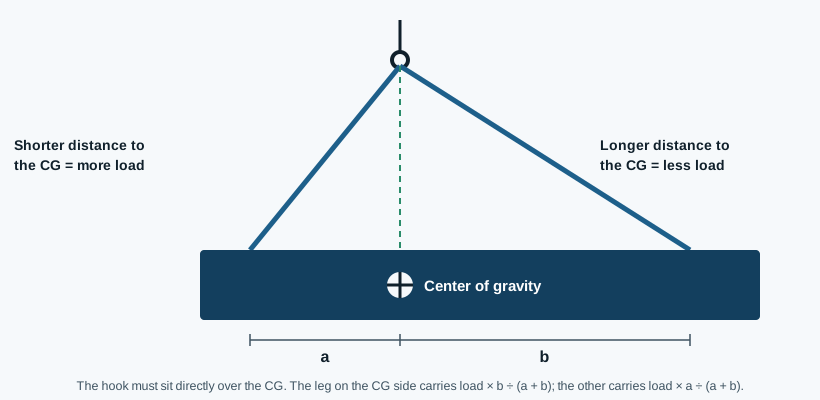
Estimating what nobody wrote down
Much of the Level II written exam is applied arithmetic. You will calculate the volume of a steel plate, a pipe section or a concrete block, multiply by a material weight, and add up components to get a total. Then you locate the center of gravity, figure each sling leg's share of the load when the hook is not centered over the balance point, and account for the extra tension that comes with shallow sling angles.
Alaska jobs reward that skill. Equipment shipped to a remote site may arrive with no paperwork, or with paperwork that does not include the insulation, fluids, packed snow or frozen-in mud riding along with it. A Level II rigger is expected to catch those gaps before the hook takes tension.
- Volume and weight of common shapes
- Center of gravity by moments
- Leg loads when slings are unequal in length
- Sling angle factors and when to add a spreader
Modules, ice roads and a short open-water season
North Slope development leans heavily on modular construction: large pieces built elsewhere, shipped north during the summer open-water window and set in place on site. Federal planning documents for ConocoPhillips' Willow project, for example, describe sealift barges carrying prefabricated modules to Oliktok Dock, with offshore lightering and then heavy-haul travel over gravel and ice roads to the development area.
Each handoff along that chain is a rigging problem: lifting from a barge deck, setting on transporters, offloading at a pad. The lifts involve tall loads with high centers of gravity, multiple lift points and often more than one crane. Level II content on equalizing gear, load turning and tandem rigging maps directly onto this kind of work, even though the exam itself is national and not about any one project.
Rigging on a deck that moves
Upper Cook Inlet has some of the largest tides in North America; the mean range at Anchorage is roughly 26 feet, and Turnagain Arm averages about 30. A barge tied at a dock can rise or drop several feet during a single long pick, which changes hook height, sling angles and the clearance between load and deck. Southeast Alaska, Kodiak and Bristol Bay add swell and wind to the mix.
On these jobs a Level II rigger thinks about timing the lift to the tide, how much the load can swing, and how tag lines will be handled from a deck that is not level. One note on jurisdiction: private-sector dock, marine terminal and longshoring work generally falls under federal OSHA's maritime standards rather than AKOSH and Subpart CC, so check which rules apply to your employer before assuming.
How the Level II exams work
Level II has a written exam and a practical exam, and both must be passed. Candidates can sit for Level I and Level II at the same time, but the Level II card is valid only while Level I is current, so keep the two renewal dates in view together. The practical asks you to work out a load's balance point, choose gear, rig with more than one hitch type and keep the load under control through the lift. Book it through the certifier and expect to travel to wherever the test is scheduled, often Anchorage or Fairbanks.
Our course prepares you for the written portion. Hands-on rehearsal for the practical needs real loads and gear, so work it into your job or arrange time with your employer.
Questions people ask
Can I skip Level I and go straight to Rigger II?
No. Level II only counts while you hold a current Level I certification, though NCCCO lets you take both levels' exams in the same session if you are ready for both.
How much math is on the Rigger II written exam?
Expect weight calculations, center-of-gravity work and sling tension problems. Our lessons walk through each type with practice questions so you can find and fix weak spots before test day.
Does Rigger II qualify me to direct multi-crane lifts on the Slope?
Certification shows your rigging knowledge, but who directs a lift is decided by the employer and the project's lift plan. Many sites treat Rigger II as one part of that qualification, alongside experience and site-specific training.
Is this course useful if I work on barges and docks?
Yes for the rigging knowledge. Weight, balance, leg loads and load control are the same over water. The regulations that apply may differ, since much maritime work falls under federal OSHA's maritime rules.
Guides that pair with this course
-
Reading a crane load chart
A plain walk-through of the parts of a load chart and the order to read them in, with the Alaska conditions that a chart quietly assumes away.
-
Rigging sling angles
The flatter a sling leg, the more tension it carries. Learn the multipliers, a field method for finding the angle, and how riggers apply it to real Alaska picks.
Courses
-
Mobile Crane
Study for the NCCCO mobile crane written exams on your own schedule, from a rough-terrain hydro in a Mat-Su subdivision to a crawler on a Kenai Peninsula bridge or a crane barged into a village for the summer.
-
Articulating Crane
Self-paced study for the NCCCO articulating crane written exams, with or without a winch, aimed at Alaska drivers who run a knuckleboom on a delivery truck.
-
Service Truck Crane
Exam prep for the NCCCO service truck crane credential, written for mechanics and lube techs who run a small telescopic crane off the back of a service body.
Line up your crane certification prep from anywhere in Alaska
Let us know the card you need — operator, rigger or signal person — and the community you work out of, whether that's on the road system or off it. An enrollment advisor writes back with a matching course and a plan for getting your written and practical exams on the calendar.
- Lessons open around the clock, on any phone, tablet or laptop
- Practice questions shaped like the NCCCO written tests
- Help mapping out where and when to take your hands-on practical
Ask about enrollment
A short form. Your details are used only to reply to you.