Content last reviewed
The one formula to remember
For a symmetrical lift with the hook directly over the center of gravity, each leg carries its share of the load divided by the sine of the leg's angle from horizontal:
Tension per leg = (load ÷ number of load-bearing legs) ÷ sin(angle)
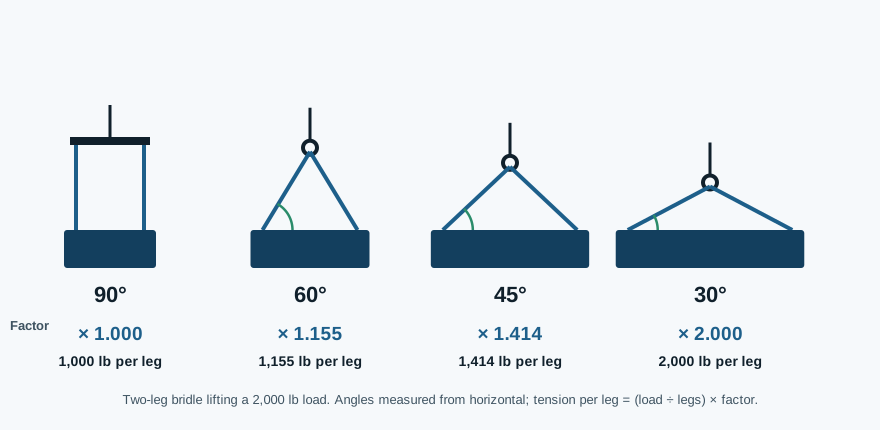
Dividing by the sine is the same as multiplying by the load angle factor in the diagram on this page: 1.000 at 90°, 1.155 at 60°, 1.414 at 45° and 2.000 at 30°. At 30°, each leg of a two-leg bridle carries the full weight of the load, not half of it. Below 30° the numbers climb steeply, which is why ASME B30.9 discourages horizontal sling angles under 30 degrees unless the sling manufacturer or a qualified person approves.
Finding the angle with a tape measure
You rarely have a protractor on a pad in Prudhoe Bay in February. You do have the sling length, and you can measure or estimate how far the hook sits above the pick points. Those two numbers give you the multiplier directly:
Load angle factor = sling length (L) ÷ vertical height (H)
Measure L along the sling from the hook to the attachment point, and H straight down from the hook to the level of that attachment point. A 12-foot leg with the hook 10.4 feet above the lugs gives 12 ÷ 10.4 = 1.15, which is a 60-degree angle. If the hook sits only 6 feet above, 12 ÷ 6 = 2.0, which is 30 degrees, and you need a longer sling or a spreader.
This ratio method needs no trig tables and works for any angle, so it is the version most riggers carry in their heads.
Worked examples from Alaska jobs
The weights below are illustrative round numbers chosen to make the math clear, not the weights of any particular piece of equipment.
- Pipe spool on the North Slope, 8,000 lb, two legs at 60°. Share per leg = 4,000 lb. Tension = 4,000 × 1.155 = 4,620 lb per leg. Choose slings and shackles rated above that in the hitch you are using.
- Modular building section in Bethel, 20,000 lb, four legs at 45°. Many riggers assume only two legs carry the load on a rigid four-point pick, because the slings are rarely exactly equal. Share = 10,000 lb. Tension = 10,000 × 1.414 = 14,140 lb per leg.
- Boat lift at a Homer harbor ramp, 6,000 lb, two legs at 30°. Share = 3,000 lb. Tension = 3,000 × 2.000 = 6,000 lb in each leg. Spreading the legs wide to clear the hull doubled the tension. A spreader bar would let the legs hang closer to vertical.
- Transformer at a Mat-Su substation, 12,000 lb, two legs at 90° from a spreader. Share = 6,000 lb, multiplier 1.000, so 6,000 lb per leg. The spreader bar and the slings above it still take angled forces, so the bar must be rated for that rigging arrangement.
Side effects of a low angle
Leg tension is only part of the story. A flat bridle also squeezes the load inward with a horizontal force that grows as the angle drops. Thin-walled tanks, crates, and light modular wall panels can buckle under that inward pull even when the slings are fine.
Low angles also load the hardware differently. Eye bolts and lifting lugs pulled sideways lose much of their rated capacity unless they are designed for angular loading, and a shackle pin loaded at an angle needs to be checked against the manufacturer's guidance. Choker hitches lose capacity as the choke angle tightens, which is a separate reduction on top of the sling angle effect.
Uneven legs shift the share. When the center of gravity is off-center, the shorter leg nearer the center of gravity takes more of the weight. Our Rigger Level II course goes further into unequal-leg calculations.
Cold, wet and frozen slings
Alaska adds a few rigging problems the textbook examples skip. Synthetic slings that get wet and then freeze can stiffen, hide cuts under ice and lose the flexibility needed to seat in a hitch. Wire rope and chain should be inspected for ice packed into the strands or links before use, and slings should be stored off the ground and out of standing water.
Cold also affects hardware. Chain, shackles and hooks have temperature ratings from their manufacturers, and some materials are not rated for extreme cold. Check the tag and the manufacturer's data rather than assuming. Our cold-weather crane operations guide covers more of the winter side of lifting.
Where this shows up on exams
Sling angle questions appear on NCCCO rigger and mobile crane written exams, often as a multiple-choice calculation with distractor answers built from common mistakes, such as forgetting to split the load between legs or using the angle from vertical instead of horizontal.
Practice until you can do the ratio method without paper. Then read your rigging alongside the crane's load chart: the rigging weight counts against the crane's capacity, and sling tension decides whether the rigging itself is adequate. The Rigger Level I course includes practice questions on both.
Questions people ask
Is the sling angle measured from horizontal or vertical?
U.S. rigging tables, ASME B30.9 and most certification exams measure from horizontal. A 60-degree angle from horizontal is 30 degrees from vertical. Mixing them up gives the wrong multiplier, so read every exam question carefully.
Why do many riggers treat a four-leg bridle as two legs?
On a rigid load, small differences in sling length or pick point height mean two diagonal legs often carry most of the weight while the other two go slack. Calculating as if only two legs work gives a safety margin for that. Follow your company's procedure and the sling manufacturer's guidance.
Does the crane feel the higher sling tension?
No. The crane hook carries the weight of the load plus the rigging regardless of the sling angle. The extra tension stays inside the rigging and the load, which is why slings and hardware can fail even when the crane is well within its chart.
What is the quickest way to raise a too-low angle?
Use longer slings, move the pick points closer together if the load allows, or add a spreader or lifting beam rated for the job. Each option raises the leg angle and lowers the tension.